

A National Science Foundation grant brought Tennessee State University students to Knoxville for a two-week summer research program.
The University of Tennessee, Knoxville, opened geoscience research opportunities for additional students through a partnership with Tennessee State University (TSU).
A three-year National Science Foundation grant allowed TSU students to attend a two-week summer program on the Knoxville campus, working alongside UT students on environmental research projects in the region.
At the R1 research university, the TSU undergraduates gained hands-on experience with specialized equipment and advanced research methods that will set them apart from other applicants to highly competitive graduate programs.
Professor Michael McKinney, a principal investigator on the NSF grant, leads the environmental studies program in UT’s Department of Earth, Environmental, and Planetary Sciences.
“After three years, it is clear that this is a very successful program that has provided important opportunities for both TSU and UT students to interact in fun and productive ways that benefit both schools,” said McKinney, who added there are plans to continue the partnership.
During the past summer, nine TSU students worked with seven UT students and conducted independent research projects as well, gaining field and lab experience.
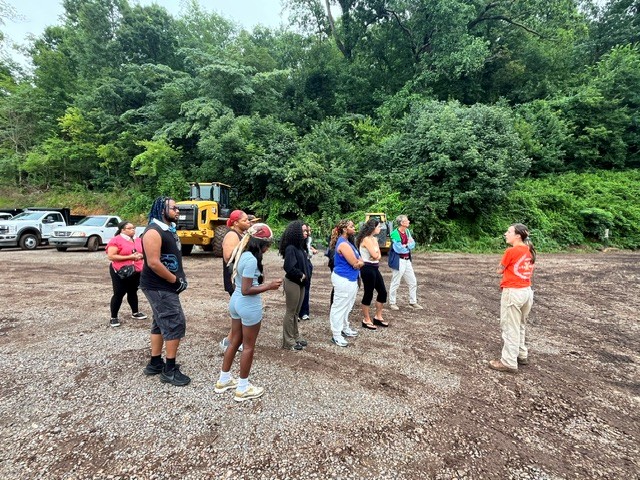
Doctoral student Taylor Wishart, who studies metal culverts and human impacts on urban streams, introduced them to water testing. Jordan Parker Noce, also a PhD student, showed how to survey tree diseases using remote sensing from drones. Dana Mills, another doctoral student who is studying freshwater mussel ecology and the impact of invasive zebra mussels, demonstrated how to collect field samples and prepare them for lab analysis.
The TSU students also visited the Great Smoky Mountains National Park with doctoral student Sonja Schmoyer, who recently received a National Geographic grant for her work using drone-based hyperspectral imaging to protect endangered hemlock trees.
Teaching Assistant Professor and Laboratory Coordinator Meilian (Maggie) Chen led work with one group in the geochemistry lab while McKinney showed them the UT Gardens and green roofs on campus. Master’s student Daniel Price, who researches evidence of water on planetary bodies, led a field trip to the rock quarry at Knoxville’s Ijams Nature Center to study geology.
In UT’s Strong Hall, PhD student Christopher Julian demonstrated how to use visible and near-Infrared (vis-NIR) spectroscopy to study materials including soils on planets. Undergraduate student Sarah Grace Cook led a presentation on how to use X-ray diffraction to study the components in geological formations, and the TSU students were encouraged to bring their own rock samples from home to test.
For their projects, three TSU students used different methods—including vis-NIR spectroscopy—to determine the presence of microplastics in makeup and toothpaste. Others tested water from urban streams for heavy metals, measured urban tree health with data collected by drone, compared microplastic breakdown in composting methods, created green roofs for desert biomes, and compared zebra mussel sizes with water quality data from East Tennessee rivers.
The summer program was part of a larger initiative that included UT and TSU faculty mentoring student research during the academic year and allowing TSU undergraduates to take four introductory geology online courses online through UT.
by Amy Beth Miller