
Research Seminars
Research seminars are year-long interdisciplinary discussion groups organized around compelling areas of intellectual inquiry. Convened by full-time faculty members (at least one of whom is tenure-stream from a humanities or arts department), research seminars should identify and explore a central question that may lead to a research outcome such as a new center, conference, journal publication, research cluster, or grant application. Working toward these outcomes, seminar participants present their work to one another, invite visiting speakers, assign readings, and perhaps work collaboratively on a research project. Public Humanities projects can be developed through the research seminar but should be directly related to the research goals of the seminar participants.
Seminars meet at least three times per semester at the Denbo Center; are open to any UT faculty member, advanced graduate students by invitation, and scholars outside of UT by invitation. Seminars typically bring together researchers from different UT departments as well as different colleges on the UT campus. The two faculty conveners take responsibility for inviting members and organizing activities agreed upon by the group, such as work-in-progress workshops or film screenings. Faculty may apply to create a new research seminar or to renew an existing seminar. More information is available to UT faculty at the Denbo Center Sharepoint site.
The deadline to submit proposals for 2026-2027 Denbo Center Research Seminars is June 15, 2027
Current Research Seminars

Appalachian Studies
Description
This seminar brings together a collaborative, interdisciplinary group of faculty and students who share interests in critically analyzing and addressing issues facing the Appalachian region. Recognizing the constructed nature of places–particularly “Appalachia”–the group explores the contested and porous boundaries, power relations, institutions, narratives, and experiences that emerge from and shape socio-ecological interactions in the region. Building upon local strengths, this seminar facilitates collaborative discussions to identify and refine the University of Tennessee’s contribution to the interdisciplinary field of Appalachian Studies, bringing in generative speakers to help shape an emergent cohort of UTK Appalachian Studies scholars. This sets the foundation for continued collaborative research applying humanities and social science perspectives toward critically understanding the region, its challenges and strengths, and potential futures.

Black Neurodiversity Studies
Description
Black Neurodiversity Studies is an interdisciplinary seminar exploring how race and neurodiversity intersect in research, clinical practice, and everyday life. The seminar brings together faculty from multiple disciplines to examine how research can better account for Black neurodiversity. The research seminar studies a wide array of texts from disability studies, autism and ADHD studies, and neurodiversity studies, and identifies existing gaps in research. The goal is to bring together a variety of interdisciplinary perspectives to build a foundation for Black neurodiversity studies as a new and cohesive area of inquiry.

Digital Games
Description
The mission of the Digital Games Research Seminar is to develop research collaborations and launch joint projects that bring together various perspectives and expertise. We strive to create opportunities to learn about each other’s work through regular presentations and informal exchanges, while fostering a culture of constructive critique. Finally, we encourage members to apply and present at conferences—individually or in panels—while also organizing conference sessions and workshops as collaborative initiatives, as well as develop article ideas and book projects, and apply for individual and collaborative grants that intersect with game studies. We believe that these activities will strengthen both the quality and visibility of our research.

Health Humanities
Description
The Health Humanities Research Seminar explores the topic of health—broadly defined—through a wide-array of disciplinary lenses. We seek to expand our individual approaches through interdisciplinary discussions and collaborations. In doing so, we engage a broad array of perspectives on health identities and authenticity via our interactions with ourselves, one another, other species, and our environment. We seek to actively disseminate our collaborative findings and broaden our means of addressing health-related topics and initiatives in the academy and our community alike.

Late Antiquity
Description
This interdisciplinary seminar brings together faculty and advanced graduate students whose research lies in the Mediterranean world of late antiquity. The range of the seminar includes the Mediterranean world of the third century C.E., defined primarily by the dominant Roman Empire; the fundamental transformations that characterized the fourth and fifth centuries, from the development of Christianity as a political power, to the collapse of the western empire and its division into various barbarian kingdoms, to the establishment of a single imperial power in Constantinople; and the new religion of Islam and further momentous transformations that ended the fundamentally Roman unity of the late antique period. The participants in this seminar are not only based in different departments, but also come from different disciplinary backgrounds. Each possesses specialist knowledge, language skills, and methodological approaches to textual and material evidence that can help inform the research of the others.
This seminar is sponsored in partnership with the Marco Institute for Medieval and Renaissance Studies.

Narratives of Food and Culture
Description
“Narratives of Food and Culture” explores social and political tensions through an interdisciplinary perspective on food production, preparation, and consumption. Food is sensual and intersects with many questions that humanities scholars address, such as history, family, memory, belonging, place, and body politics. Yet food also is often rendered mundane as a simple necessity of everyday life. In our seminar, we seek to explore creative and interdisciplinary approaches to food studies, including food stories, global historical connections, food access, and food politics. The longer-term vision for our seminar is to create a collective of food studies scholars on campus, to connect with the community, and to work on digital food story maps to explore local food systems and their global connections.

Native American and Indigenous Studies
Description
The purpose of this seminar is to build greater community and conversation among researchers at UT who are working–some tangentially and others centrally–on issues in Native American and Indigenous Studies, either in content, methods, or activism. The seminar draws widely on methodological and theoretical issues involving gender, sexuality, sovereignty, settler colonialism, epistemology, and environmentality. We ask questions such as: what is NAIS? What are its key methods? How does it illuminate multiple fields? What is the future of NAIS? By drawing on broad methodological readings and interdisciplinary applications we wish to demonstrate to UT admininstration and other researchers that questions of indigeneity are (or should be) at the heart of our academic inquiry, that the core issues of NAIS are at the heart of many of the fields of research represented at the University. In this seminar, we hope to bring together a vast interdisciplinary network of scholars invested in the presence of NAIS at UTK.

Nineteenth-Century British Studies
Description
This seminar explores all aspects of literature and culture during the “long nineteenth century,” encompassing the Romantic and Victorian periods. We have an inclusive interdisciplinary approach and we collaborate with faculty in eighteenth-century British studies and nineteenth-century American studies. We read primary texts (fiction, non-fiction, poetry) as well as the latest critical works. Our topics of discussion are usually driven by the research of our members and by the speakers we host. Recent areas of focus have included transatlanticism, economic theory, biography, musical performance, and radical politics.

Speculative Authenticity
Description
This seminar explores how speculative logic has become a key research method across disciplines, countering rational empiricism and opening new space for hypotheticals, imagination, and futures thinking. Rather than defaulting to a binary between “truth” and “fantasy” or “fiction,” we explore how speculative thought is authentic and is now a primary, if oxymoronic, path to creative innovation and “truth” in the sciences, data sciences, arts, humanities, and social sciences.
Core Team
- Emily Ward Bivens, School of Art
- Tova Holmes, Department of Physics and Astronomy (Physics)
- Sean Lindsay, Department of Physics and Astronomy (Astronomy)
- Lawrence Lee, Department of Physics and Astronomy (Physics)
- Julie Lohnes, School of Art
- Andrew Madl, School of Landscape Architecture
- Faye Nixon, School of Landscape Architecture
- Eleni Palis, Departments of English and Cinema Studies
- Maria Stehle, Departments of Film Studies and World Languages and Cultures (German)
The Transatlantic Eighteenth Century
Description
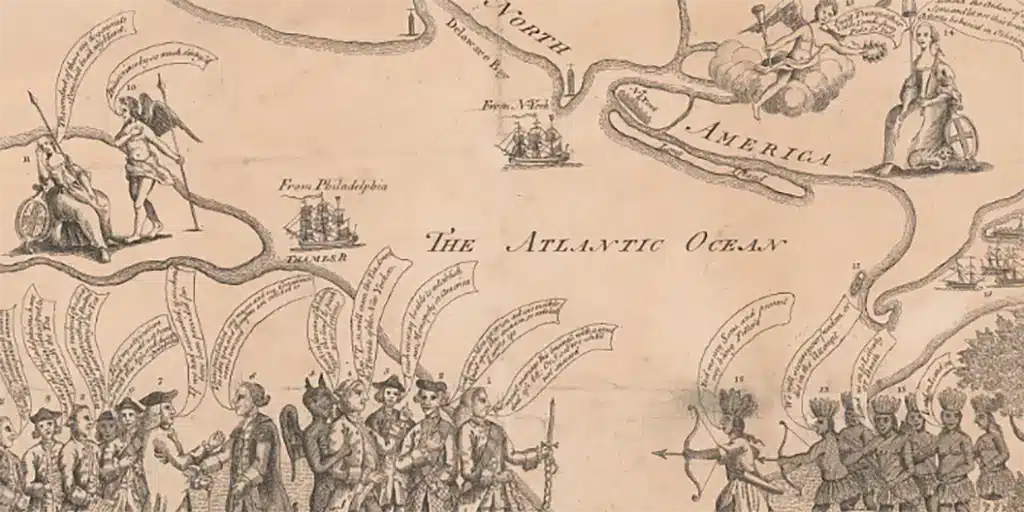
The aim of this seminar is to bring together faculty and advanced graduate students who share an interest in the “long eighteenth century” (1688 to 1815), a period framed by the Glorious Revolution in England that marks its beginning and the American, French, and Haitian Revolutions that signal its end.
The work of our seminar participants reaches across North American, British, French, German, and the Caribbean as eighteenth-century studies confronts the global impact of empire and the forging of the transatlantic modern world. We seek to support each other’s work through rigorous interdisciplinary analysis that enhances the production of knowledge about a past that is never past.
For more detailed information, view the seminar schedule.
Past Research Seminars

Black Women and Research from USA and the Caribbean: Our Paradigms of Preference
Description
This seminar is designed to create a rapport among Black women scholars, primarily in the Humanities and Social Sciences, who are teaching and research faculty at the University of Tennessee. Its aim is to build relationships, construct a community (or multiple communities), encourage collaborations, and learn more about our colleagues. This seminar seeks to understand what drives us as scholars, how we design or create our research, and what are the theoretical paths and paradigms that best define or guide our trajectories (publications) as researchers. Themes and descriptions of presentations proposed by participants include: Self-Discovery and Black Female Identity; Black Feminist Literary Criticism Within a Historical Perspective; Intellectual Autonomy, Creating Our Own Paradigms of Historiography and Literary Configuration; Geographic Agency and the Urban Space; and Memory, Re-memory, and National Identity Formation.

Gender and Sexuality in Historical Perspective
Description
This research seminar brings together faculty and advanced graduate students working on projects that engage the theme of gender and sexuality in historical perspective. Encouraging academic exchanges across disciplinary boundaries, this seminar will meet regularly for research presentations by affiliated faculty and graduate students, lectures from invited speakers, and discussions of current scholarship. Deliberately broad in scope, this seminar will explore gender in a wide variety of historical periods and geographic contexts. Among the questions we will ask are how a gender analysis can shape studies of sexuality and ideas of the body; the ways in which race, ethnicity, class and gender are relationally constituted and intersect in historically important ways; and finally, the ways in which a gender analysis can help illuminate major political transformations.

After Wars
Description
What happens when the roar of battle and the clash of arms at last die down? The aftermath of any war presents problems and challenges of a different order than the imperative of victory during the conflict. This seminar brings a comparative humanistic approach to the entire problem of what happens after wars, which remains a crucial question in our own contemporary world. This is also a topic which is now being fully engaged in different fields of humanistic scholarship, from history to literary studies. We confront key questions about how the aftermath of war has been shaped at different times and in different places in the distant and more recent past.

Rethinking Space and the Uses of GI Science in Digital Humanities
Description
This seminar aims to bring together faculty and graduate students to discuss new developments and potential areas for collaboration around the idea of “the spatial turn” in historical studies. Aided by the rise of digital humanities programs, institutional projects, and forms of accessible digital storytelling, there has been a growing interest in the “spatial turn” in history, transforming how we understand regions from the American West to the spaces of modern England. Yet such success raises important research questions. What are the limitations of technology for the spatial turn? What is the significance of the spatial turn for histories of parts of the world (such as East Asia) that have their own historical and geographical traditions that long predate the arrival of Western spatial conceptions?
Contact
Shellen Wu