
Research & Creative Activity
-

More to Explore in Appalachian Studies
The University of Tennessee, Knoxville, sits squarely within Appalachia, and a group coming together from across campus aims to enhance the scholarship, creative activity, and community engagement with the region and across disciplines. A recent Appalachian Studies Showcase highlighted opportunities already available in areas ranging from scientific research to art to law. “Our vision for…
-

Students Flex Professional Skills in Symposium
Winning research presentations highlight professional growth opportunities for arts and sciences students. Thirty-two undergraduate students from across the College of Arts and Sciences earned top scores for their research and creative achievements during the Arts and Sciences Undergraduate Research Symposium (ASUReS) on April 9. Winning presentations were recognized during an awards reception on April 28.…
-

Armsworth Named Fellow of Ecological Society of America
Professor Paul Armsworth elected as a Fellow of the Ecological Society of America. The Ecological Society of America (ESA) announced Professor Paul Armsworth, Department of Ecology and Evolutionary Biology, among its cohort of 2025 ESA Fellows. He joins seven other new fellows and 10 new early career fellows. The fellowship status recognizes the many ways…
-

Lessons to Learn from Fascinating Ferns
Jacob Suissa is known for his enthusiastic approach to teaching about botany, both in the classroom as a professor of evolutionary biology at UT and through the non-profit “Let’s Botanize” social-media platform. He has now channeled that green-world energy into a new book about the complex history of one of the planet’s most enduring plants.…
-

Drone Adds Detail to Crater Study
Researchers from the University of Tennessee, Knoxville, have shown that when they use cameras mounted on a drone, they can develop a digital model of a crater faster and with more detail than previously possible. Their study, “A Drone-Based Thermophysical Investigation of Barringer Meteorite Crater Ejecta,” was published in the February 2025 issue of the…
-

Annual Awards Recognize Excellence in Arts & Sciences
Faculty Honored at the Annual College of Arts and Sciences Convocation The College of Arts and Sciences hosted its annual awards ceremony on Monday, March 31, 2025, at the UT Conference Center in downtown Knoxville. The annual ceremony honors faculty members in all areas of the college’s mission, selected by their colleagues as representatives of…
-
Symposium Features Undergraduate Research
The Arts and Sciences Undergraduate Research Symposium (ASUReS) provides a venue for undergraduate students across all disciplines in the college to showcase their research and creative achievements in individual or group projects or their contributions to class capstone projects. ASUReS, pronounced “azures,” offers an opportunity for research Vols to gain experience in delivering professional presentations…
-

Microbial Manners on the High Seas
Sargasso Sea plankton and other marine microbes take turns sharing nutrients. A new study co-authored by Steven Wilhelm, Kenneth and Blaire Mossman Professor in microbiology; Joshua Weitz, mathematical modeling professor at the University of Maryland; and team found that microbes in the Sargasso Sea divide nutrients throughout their communities over time, supporting coexistence and efficient…
-

Choice Overload
Does it get overwhelming? UT faculty team investigates how animals react to overwhelming options. Humans can have a lot to consider when working out the best choices for their needs: buying a car, choosing a home, or just shopping for groceries. An overwhelming number of options can give a person pause. Animals experience this same…
-
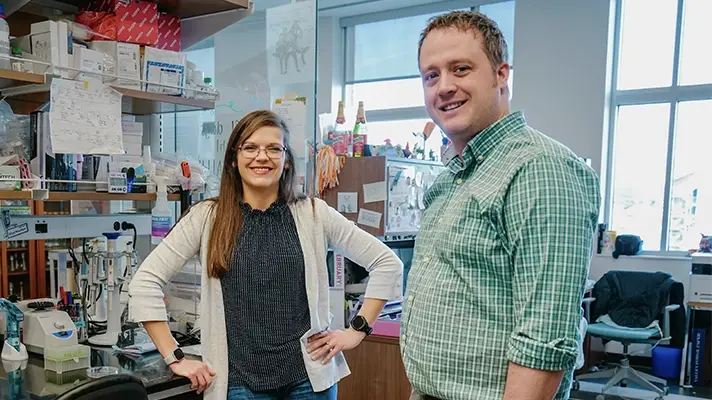
Monteith Lab tracks immune response
Assistant Professor Andrew Monteith’s lab in the Department of Microbiology is documenting how key immune cells detect infection and how that fails to happen in people with lupus. Research Associate Ashley Wise led a study focused on neutrophils, the most abundant type of immune cell, and how their mitochondria function as sensory organelles to detect…