
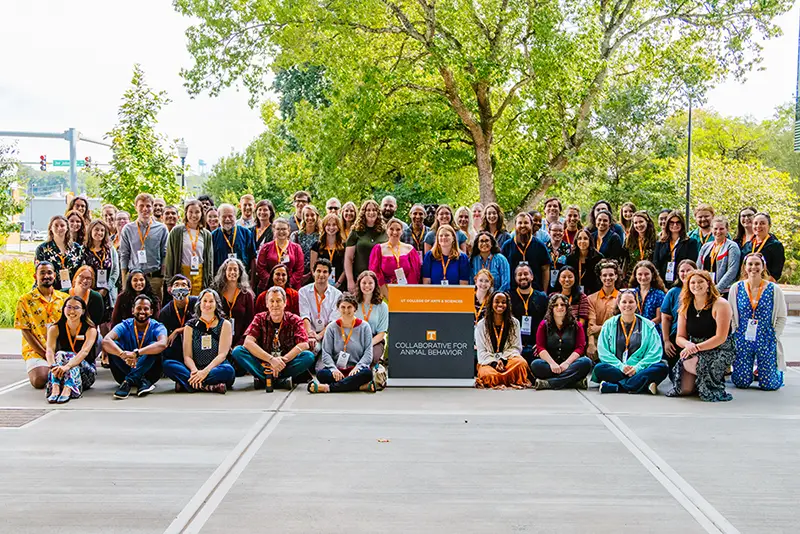
Inaugural CoLAB research gathering shines a light on UT expertise in animal behavior.
The college’s Collaborative for Animal Behavior (CoLAB) hosted the Southeastern Conference for Animal Behavior (SeCAB) on September 26–27. Researchers gathered to explore the dynamic interactions between animal behavior and environmental change, and to mobilize and expand the network of behavioral biologists in the Southeast.
“Hosting SeCAB was a milestone moment for CoLAB,” said Professor Elizabeth Derryberry, director of the center. “This inaugural conference drew researchers and students from more than a dozen universities across the Southeast. It put our faculty and students on the map as leaders in the study of animal behavior in a rapidly changing world.
The meeting emphasized behavior in the context of environmental change, allowing CoLAB to help steer the scientific conversation toward integrative approaches that link behavior with physiology, ecology, and evolution. The discourse helped spotlight the center’s role in connecting scientists in ecology and evolutionary biology, psychology, veterinary medicine, animal science, and neurobiology.
Nationwide Collaborations
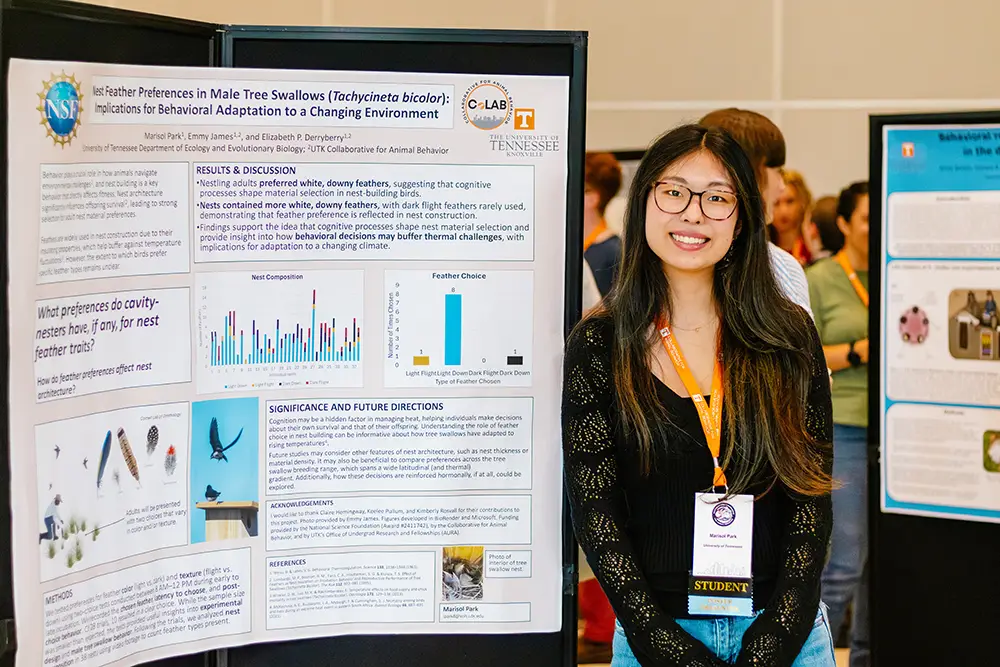
“Our faculty study everything from acoustic communication and decision-making to thermoregulation and brain–behavior relationships,” said Professor Todd Freeberg, program chair of the center. “SeCAB gave us a stage to demonstrate that breadth and to show how CoLAB brings these perspectives together. We wanted participants to leave knowing that UT is a vibrant hub for animal behavior—a place where collaboration truly drives discovery.”
CoLAB faculty were able to establish relationships that extend into national networks and spark new collaborative projects.
“We’re already seeing momentum around new proposals and working groups,” said Assistant Professor Claire Hemingway, Departments of Ecology and Evolutionary Biology (EEB) and Psychology and Neuroscience. “That’s how leadership in science begins —by bringing people together around exciting, shared questions.”
Conference Highlights and New Connections
SeCAB highlighted the creativity of research methods with presenters sharing advances in techniques such as automated behavior analysis using AI, experimental temperature manipulation in wild populations, and the integration of behavioral and physiological data streams.
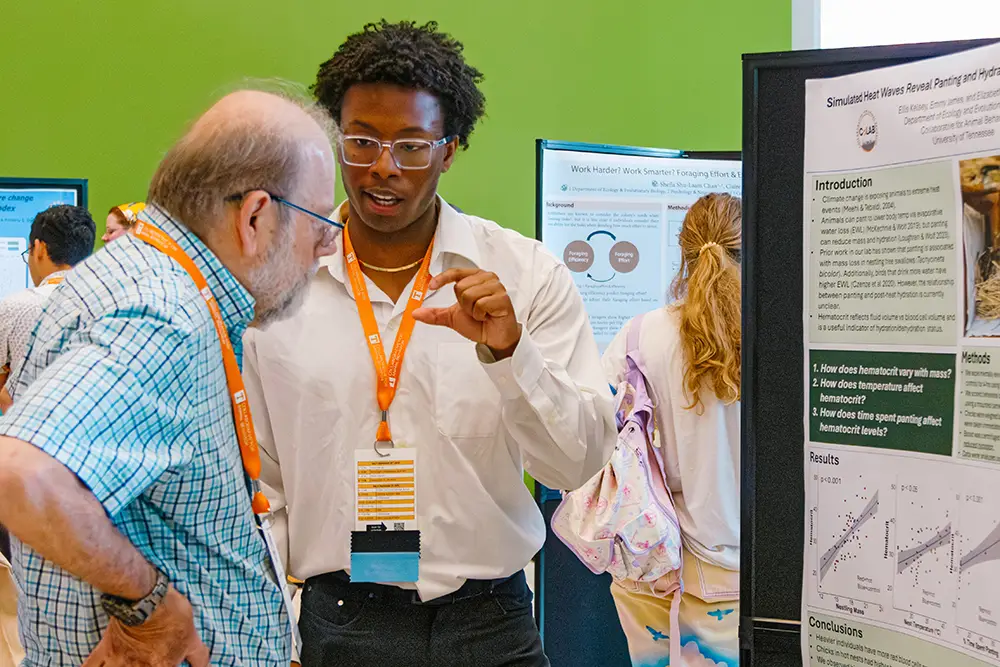
It proved to be a transformative opportunity for students and postdoctoral researchers, who presented talks and posters alongside senior scientists, chaired sessions, and networked with potential mentors and collaborators.
“Opportunities like this help launch careers and build professional confidence. Several graduate students presented innovative field experiments that connect fine-scale behavioral observations with large-scale environmental data,” said Emmy James, PhD candidate in EEB. “These approaches are transforming how we understand behavioral flexibility. SeCAB reminded us how powerful it can be to view behavior as the meeting point between organisms and their environments.”
Discussions sparked ideas for new projects across multiple levels of biological organization—from genes and neural circuits to social networks and ecosystems.
For UT faculty, it strengthened research visibility and opened doors to regional partnerships.
“For UT researchers, that means expanding behavioral ecology to include not only how animals respond to change, but how their behaviors feed back to influence ecological and evolutionary processes,” said Derryberry. “The energy from SeCAB reinforced our vision for CoLAB—to use behavior as a lens for understanding and predicting life’s resilience in a rapidly changing world.”
By Randall Brown