
WGS Adds Women’s Health Degrees
Women, Gender, and Sexuality program keeps the interdisciplinary pace and launches new major and minor in women’s health.
The Women, Gender, and Sexuality (WGS) interdisciplinary program gives UT students opportunities to explore the ways that these topics intersect to shape the past, present, and future of human cultures and societies. The curriculum connects classes from across the university that expand student worldviews while preparing them for innovative careers in a wide range of fields: anthropology, psychology, English, history, geography, political science, nursing, and other disciplines.
As part of the college’s Consortium on Social and Cultural Inquiry (CoSCI), WGS recruits consistently from all academic programs, with courses providing students with a variety of methods, skills, and perspectives for conducting their own research, creative activity, and activism. Program graduates might take these skills on to medical school, law school, and other postgraduate programs; work at national nonprofits; teach in various educational contexts; and build careers in a variety of fields.
“One of our goals was to broaden the range of interdisciplinary methodologies and courses that our students have access to,” said Professor Nora Berenstain, WGS program chair. “We’ve expanded our curricular offerings to incorporate dimensions of inequality that intersect with gender and sexuality, such as race, class, and disability. We’ve cross-listed a number of fantastic courses offered in sociology, Africana studies, and anthropology, which we are excited for our students to take.”
WGS Adds Women’s Health Major
The program offers a major and minor in WGS, a minor in LGBTQ+ studies, and launched a major track and a minor in women’s health in fall 2025 that has already garnered significant interest from students.
“We expect to recruit even more majors and minors as students learn about the programs,” said Alexandra Chiasson, associate WGS chair and teaching assistant professor. “We also expect the new major and minor to help spread awareness of the WGS program in general. Not many students come to college already familiar with what WGS is, but many students have familiarity with women’s health as a potential area of study.”
The women’s health major and minor give students who are interested in medicine and healthcare professions an opportunity to specialize with a focus on structural determinants of health, reproductive and sexual health, and the broader social and environmental factors that determine outcomes within healthcare systems.
“Many of our new majors and minors are combining the women’s health curriculum as a minor or second major with the college’s pre-health program, the public health major, or a major in psychology,” said Berenstain. “One of our goals is to generate interest in the women’s health track as a pathway for students who wish to pursue advocacy and nonprofit work. We are excited to see where students find value in the new programs and the coursework combinations that they create to suit their interests and career goals.”
As with most interdisciplinary programs, WGS academic programs offer ways for students to “choose their own adventure”—creating their own coursework plans encompassing a spectrum of topics and experiential learning opportunities.
“WGS students have the incredible opportunity to take courses across the college that excite them, something alums consistently report is a tremendous asset in their professional and personal lives after UT,” said Berenstain. “If you are a student who has expansive interests across disciplines, you can take a course on race, science, and medicine and one on gender and sexuality in Chinese cinema all in the same semester.”
WGS Activities, Successes, and Goals
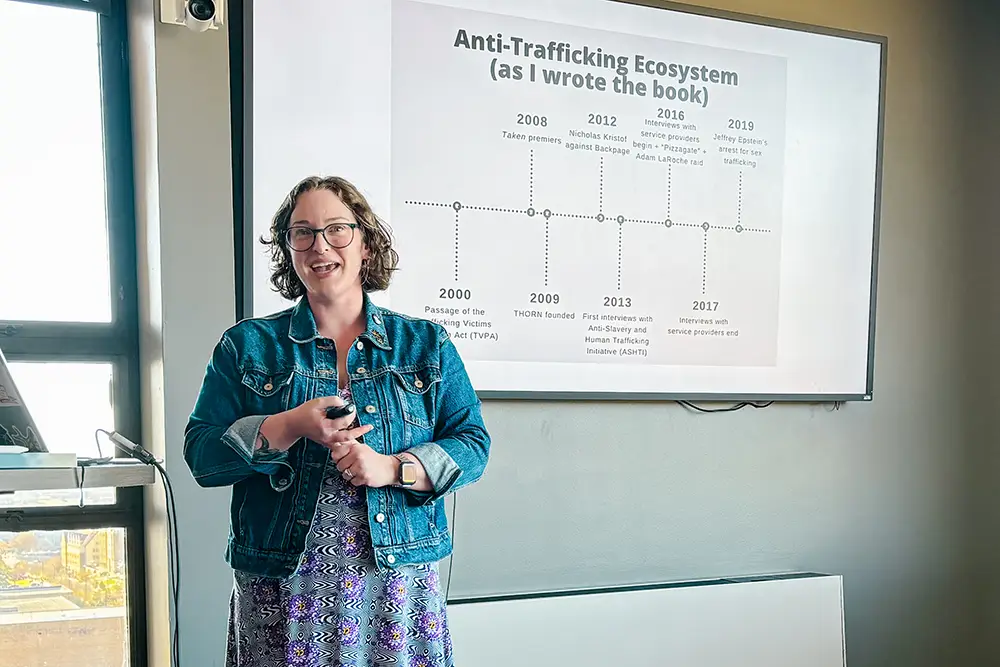
Over the last year, WGS hosted a Halloween movie night, a virtual lecture by activist Melvenna Fant-Jones on “Community Organizing for Gender-Based Violence: Advocacy, Action & Empowerment for Black Survivors,” and co-sponsored events like a Scopes Trial Centennial lecture by Banu Subramaniam titled “Scope(ing) Darwin’s Entangled Banks: Plant Worlds and the Afterlives of Empire.”
“This year, we had an incredible turnout for a talk by our own WGS core faculty member Danielle Procope Bell, ‘We have to protect our minds and our bodies: (Un)Strong Black Women and Black Feminist Disability Politics,’” said Chiasson. “We also hosted a lunch and lecture by Corinne Schwarz on ‘Policing Victimhood and Beyond: Future Directions in Anti-Trafficking Scholarship.’”
Chiasson held sessions throughout 2025 for a new careers group where students discuss potential career paths, professionalization, and job applications. The sessions will continue for 2026, with all WGS majors and minors welcome.
Also in 2025, WGS endowment funds allowed them to sponsor a graduate and an undergraduate student to travel to Atlanta and present their original research at the WGS South Conference.
Looking ahead, the WGS program has plans for more student-engagement activities and expanding their digital presence through Vols Online.
“In spring 2026, we are co-sponsoring a number of events, including the Native American and Indigenous Studies symposium, featuring speakers Krystal Tsosie and Maggie Jackson,” said Berenstain. “We also aim to increase online instruction offerings for WGS courses. As of now, it is possible to get a minor in WGS taking only online courses. We hope to expand our range of offerings so that a fully online major will be possible.”
By Randall Brown