
Scholar Spotlight: Xinyue (Evelyn) Zhao
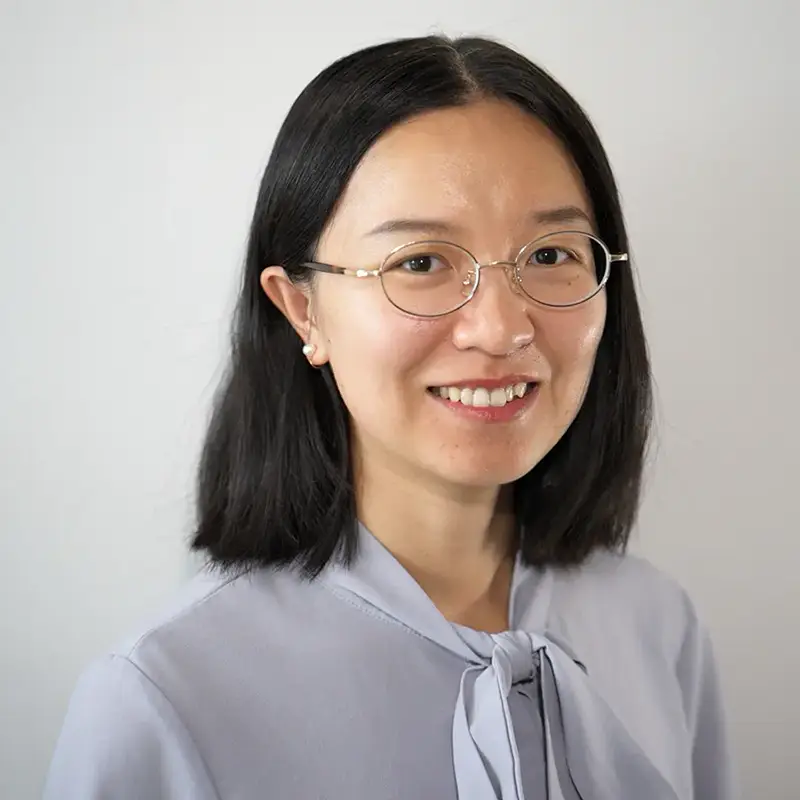
“I use mathematics to understand how things change and grow, like how tumors expand, how ice melts, or how diseases spread. My work helps predict what might happen in these systems so scientists and doctors can make better decisions.”
Xinyue (Evelyn) Zhao
Assistant Professor
Department of Mathematics
I study partial differential equations, especially free boundary problems, motivated by real-world phenomena such atherosclerosis and phase transitions. I combine analytical techniques, bifurcation theory, and machine-learning–based methods to understand stability, pattern formation, and optimal control in these systems.
Free boundary problems capture situations where both the state of a system and the evolving boundary must be solved simultaneously. This interplay leads to deep mathematical questions and powerful applications in physics, biology, and materials science.
Why I Do What I Do
I was first drawn to mathematics because I find it beautiful: different ideas from separate areas often connect in surprising and elegant ways. In graduate school, I studied the Stefan problem, a classical free boundary problem describing how ice melts, and I was fascinated by how such equations capture real physical changes. I soon realized that free boundary problems provide a powerful way to model many biological processes as well, and that discovery continues to motivate my work today.
Currently Working On
We recently completed a project designing optimal treatment strategies in a tumor growth model formulated as a free boundary problem. Moving forward, we plan to extend this work by considering more complex tumor shapes and more realistic treatment delivery mechanisms.