
Scholar Spotlight: Anna Marshall
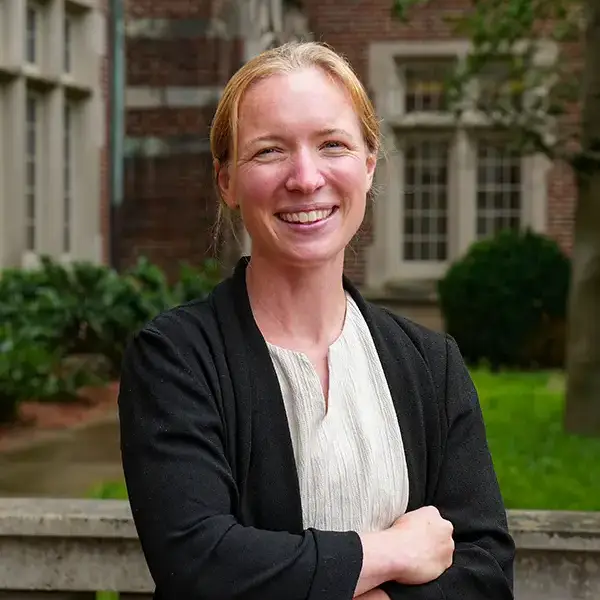
“As a fluvial geomorphologist I study how rivers shape the landscape and how people, in turn, shape rivers.”
Anna Marshall
Assistant Professor
Department of Geography and Sustainability
My research explores physical processes that sustain ecosystem functions in rivers and what it means for rivers when those processes are lost due to legacies of human activity. I identify ways to restore riverscape function and resilience, working with a wide array of partners to integrate research findings into on-the-ground management and policy.
Rivers are always changing: They’re sensitive recorders of landscape history, revealing how climate, geology, biology, and human activity interact across a wide range of spatial and temporal scales. To really understand how humans influence those processes, we first have to understand how rivers function when they’re left to their own devices—when flow, channels, and floodplains haven’t been heavily modified.
I’ve spent a lot of time studying those kinds of rivers, because they show us what it looks like for a river to be dynamic and often more resilient in the face of disturbance. I’m also really interested in the flip side—how decades of human alteration have changed river behavior, and what we can do to bring back some of that more dynamic function and resilience.
In short, it’s about figuring out the “who, what, where, when, why, and how” of river change and using that knowledge to guide restoration and recovery.
Why I Do What I Do
I spent just about every free moment as a kid playing in whatever body of water I could find or building little channels of my own.
During my undergraduate degree, I learned how to read rivers as a scientist for the first time, and I was hooked.
After that, managing ecological restoration projects as a practitioner showed me how river science can make a real difference on the ground. Eventually, those experiences pushed me toward wanting to better understand the processes that shape how rivers work and respond to change.
Now, I aim to bridge research and practice to support rivers and communities— and to share that same appreciation and curiosity for the natural world with students through immersive, field-based learning.
Currently Working On
Two new projects my research group has launched over the past year are rooted in the rivers of Southern Appalachia.
One examines how headwater streams responded to extreme flooding after Hurricane Helene and the role these small catchments play in shaping downstream flood impacts.
Parallel to that, we’ve built an Appalachia-focused flooding working group as part of the Institute for Climate and Community Resilience that brings together researchers from across the College of Arts and Sciences and the broader campus community. It’s been a great way to combine different areas of expertise, leverage ongoing research into a collaborative setting, and translate that directly to community needs.
The other new project investigates how rivers recover following restoration efforts to improve aquatic connectivity and habitat—through dam removal and wood augmentation—in the Cherokee National Forest. The project is a collaboration among students and staff in the Department of Geography and Sustainability and faculty in the School of Natural Resources, creating opportunities for hands-on learning across disciplines and shared fieldwork.