
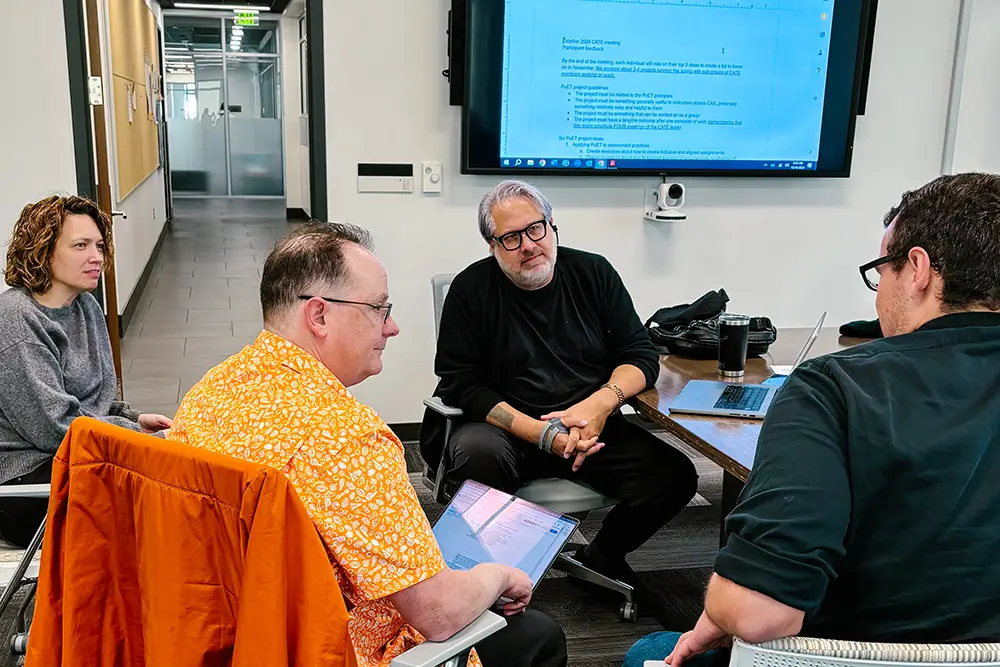
CATE shines a light of excellence on teaching at UT.
The high caliber of teaching offered at UT is a cornerstone of the unparalleled experience for students at Rocky Top. The Community of Scholars for Advancing Teaching Excellence (CATE) was established within the College of Arts and Sciences to focus and build on this aspect of faculty work.
The idea for CATE was sparked by a survey of award-winning teachers across the UT campus. CATE Director Elisabeth Schussler, a professor in the Department of Ecology and Evolutionary Biology, worked with UT’s Teaching and Learning Innovation (TLI) office on the survey to pinpoint elements that define teaching excellence, ultimately producing an institutional guide.
“After two years of work, we unveiled the Principles of Excellence in Teaching (PoET),” said Schussler. “Subsequently, we formed a community of instructors across the college who further collaborate to create resources that other faculty can use to advance teaching in alignment with PoET.”
Twenty-one arts and sciences faculty members joined CATE since launching in 2024.
“Just knowing that faculty were willing to gather to work on teaching initiatives was a measure of success,” said Schussler. “Faculty don’t have a lot of extra time—contributors were doing this because they are passionate about the teaching mission of the college and wanted to use their expertise to help others.”
CATE launched with funding support from the college for its mission in strengthening an interdisciplinary, collaborative faculty community.
“CATE fosters vital initiatives in which faculty work together to share the PoET principles and mentor new faculty members joining the college,” said Interim Executive Dean Robert Hinde. “This forward-thinking approach to teaching excellence is a key part of the academic advantage our college gives students and helps us deliver a next-level educational experience across the college.”
Excellence for Students in Any Space
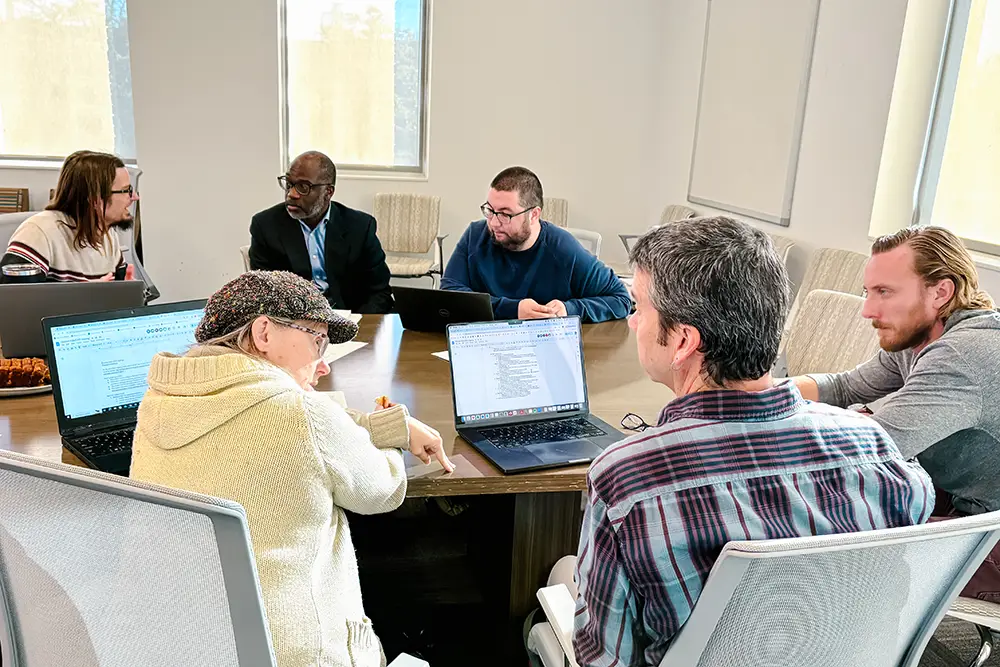
One CATE team focused on the different ways to engage students according to what type of classroom space is involved. They generated ideas that caught the attention of several campus partners who coordinate space usage and planning, including units such as OIT and the institutional space committee. Their work documented the seating, technology, and pedagogical tools in classrooms and considered how these elements translate into the best way to engage students in these spaces.
“Not all classrooms are built the same,” said Caroline Wienhold, CATE leadership team member and Faculty Fellow for natural sciences and mathematics. “What you do in a classroom where you can walk up to each student at tables is different from a room with steep stairs, compressed rows, or pull-up desks. We are curating engagement strategies for each style of large classroom available at UT.”
The group worked closely with the Office of the Provost and OIT to explore student needs from space to space.
“Linsey Graff in the provost’s office has been a great partner in encouraging this project,” said Wienhold. “Rachael Stanley in OIT has been doing amazing work on upgrading and adding utility to classrooms.utk.edu. We are partnering with them to bring our teaching expertise—as users of the large classroom spaces—to continue to expand the utility of existing resources.”
Peer-to-Peer Excellence
CATE member Neno Russell, associate professor in theater, works with TLI’s Ferlin McGaskey to develop a peer-observation protocol to create a more informal approach that can be used among faculty or graduate students to give teaching feedback. TLI has an existing, PoET-based framework for formal observations—the kind of documentation that faculty might include in a tenure dossier.
“We’ve been working on something that complements that: a more informal, conversational, ‘coffee-and-chat’ version of peer observation,” said Russell. “Our goal is for the CATE Peer Observation to serve as a helpful stepping-stone toward the more formal TLI matrix.”
The team is finalizing this new framework with plans to share it with faculty across the college spring 2026. Feedback from faculty will help provide TLI with a useful peer-to-peer tool.
“Our hope is that this framework will support early-career faculty who want informal, low-stakes advice on their teaching from more experienced colleagues,” said Russell. “It will also allow early-career faculty to observe senior faculty and learn from their approaches. Importantly, it will extend to graduate teaching assistants and postdocs, offering them and their mentors a practical, accessible way to engage in ongoing teaching development.”
Building Excellence from Multiple Experiences
Just as not all class spaces are built the same, faculty members also thrive via their own unique approaches. CATE brings together groups of instructors with multiple viewpoints to build a bigger picture of teaching excellence.
“What works in one person’s classroom doesn’t necessarily work in everyone’s classroom,” said Schussler. “Integrating the experiences of multiple individuals together is a real strength.”
CATE also draws from published literature on teaching and learning in higher education to balance practice with theory.
“As someone who focuses on biology education research as my disciplinary area, I know that for almost any instructional topic you want to know about, there is a paper that can inform your thinking,” said Schussler.
The CATE initiative led to a collaborative grant proposal that earned funding from the National Science Foundation, focusing on skills that enhance both teaching and research excellence for graduate students in natural sciences and mathematics. Ongoing projects continue into 2026, with one new project considering how reflection on teaching experiences can be used as a tool to improve practice. These focused projects —and the very conversations and collaborations guided by CATE—further strengthen the foundation for what the arts and sciences community offers students and each other.
“The opportunity to work together on teaching—not just faculty to faculty, but also faculty working with staff, committees, and other units—is a valuable reminder,” said Schussler. “When we pool our knowledge, we can advance not just teaching but also facilities and procedures that support teaching, and UT is better for it.”
By Randall Brown