

Featured Projects
CPSE members study space from a wide range of scientific disciplines. The following list highlights examples of ongoing research currently conducted by CPSE members.

Hannah Herrero
Modeling leafy greens physiological and biochemical responses to light intensity and successive harvest
The long-term goal is to aid in the facilitation of long-term space missions by establishing environmental conditions and cultural factors required for optimal leafy greens growth, nutritional value, space- and energy-use efficiency, and labor by modeling crop physiological and biochemical responses. The overall objective of the project was to improve and quantify the consistency, phytonutrient quality, and productivity of cut-and-come-again mizuna by identifying suitable cultivars, determining the optimal light intensity and photoperiod, and quantifying changes over time in ISS-like environmental conditions.

Nick Dygert
Deep Dive
Within EEPS, the Dygert lab group is involved in an NSF-funded exploratory research cruise to the Mariana Trench. They embarked on a 3-week expedition aboard the research vessel Thomas G. Thompson to the Challenger Deep Forearc Segment (CDFS) in collaboration with scientists from seven institution across four countries. Aboard the cruise, they used the remotely operated vehicle tandem Jason-Medea to directly sample lower crustal and upper mantle exposures from the overriding Philippine Sea Plate at depths of up to 6,500m. The CDFS is a unique locality where it is possible to sample lower crustal and upper mantle material associated with an active subduction zone in situ due to low sediment supply and diffuse extension. Additionally, southernmost part of the Mariana arc potentially provides an analog for immature island arcs and subduction initiation. We will apply a suite of geothermometers and oxybarometers to acquired gabbros and peridotites to begin to understand how subduction influences mantle lithosphere formation at the CDFS. Subduction is a tectonic process unique to Earth, so understanding how subduction begins will help clarify why we do not see this on other rocky bodies in the Solar System.
Jill Mikucki
Deep Dive
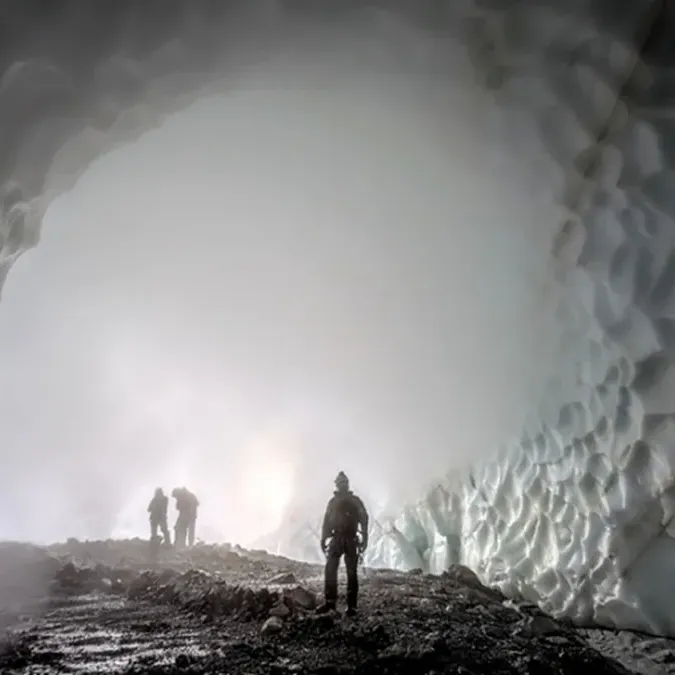
Projects in the Mikucki Lab are driven by our curiosity about sub-ice environments. We study extremophiles, microbes that thrive in harsh conditions, as analogs for what life might look like on other planets. Our team also collaborates with engineers who design ice-melting robots, or cryobots, that collect samples from deep beneath glaciers. Some of our investigations require trekking across glaciers to reach subglacial caves. Recently, members of the lab explored Mt. Baker, which hosts an active fumarole system and ice coves These volatile environments, with high concentrations of gases like hydrogen sulfide and carbon dioxide, host extreme microhabitats for microorganisms. This cave contained striking natural deposits of sulfur and iron, offering a glimpse of the chemistry and life below ice.

Nick Brey
Dragonfly
The DraGNS instrument on Dragonfly will be tasked with analyzing the elemental composition of Titan’s surface materials. Studying molecular excitations, such as rotational and vibrational energies and phonons is important for understanding how neutrons will scatter in the Titan environment. How low energy thermal neutrons interact with molecules are described by Thermal Neutron Scattering Laws (TSL). Our project aims to improve our understanding of neutron interactions with Titan’s surface materials by generating TSLs to be used in Monte Carlo simulations. Accurate thermal scattering data could allow us to discern between the different hydrogen-bearing host molecules present on Titan.

Sonja Schmoyer and Jeff Moersch
Inverted River Channels on Earth and Mars
One of my ongoing research topics aims to leverage hyperspectral and thermal imaging to analyze well-studied terrestrial inverted river channels (IRC) and investigate how their spectral and thermal properties correlate with different formative mechanisms, starting with a comparison of burial and exhumation and gravel armoring.
We completed flights of the buried and exhumed IRC in Summer 2025 operating a Mjolnir VS-620 hyperspectral imaging system from a Cessna Skywagon 180 fixed-wing aircraft. The Mjolnir camera captures 449 spectral bands across the 400–2500 nm range at a spectral resolution of 3.3–5 nm (~1 m/pixel from an altitude of ~3000 ft). In addition, both visible (RGB) and thermal (8-14 µm) UAV flights (~2-9 cm/pixel) will be conducted to capture the information required to calculate apparent thermal inertia in Spring 2026.
The goal of this study is to establish diagnostic remote sensing signatures for each formation type in terrestrial settings, to provide a framework for interpreting the origin and paleoenvironmental significance of sinuous ridges interpreted to be inverted river channels on Mars.