
College Inspires Students on Their Odysseys
Through the lens of one short story, an English professor encourages new UT students to take initiative in mapping their journeys.
For students navigating their first year at the University of Tennessee, Knoxville, a short story set in the last century provides perspective for their path ahead.
Since 2024, the Odysseys program created by English Professor Urmila Seshagiri, Distinguished Professor in Humanities, has invited students enrolled in the College of Arts and Sciences to see themselves through the story of a young man who leaves his home in India to study and work abroad.
As part of the First-Year Studies course, students read Jhumpa Lahiri’s “The Third and Final Continent,” and in early September, Seshagiri delivered a powerful lecture that challenged them to think about their lives and their education in new ways.
Seshagiri wanted to create a new version of UT’s Life of the Mind program, which previously invited incoming freshmen to read a book over the summer and then participate in discussion groups. “I wanted something with more immediate, focused energy, a program that could make students’ eyes light up when they see what a university education can be,” she said.
“Students want to be awed by something when they come to college, but they don’t always know how to find out what will move them,” she said. “Odysseys allows them to think about what they don’t yet know, about the life-changing act of reading, and about how important it is to connect with professors.”
Becoming the Narrator
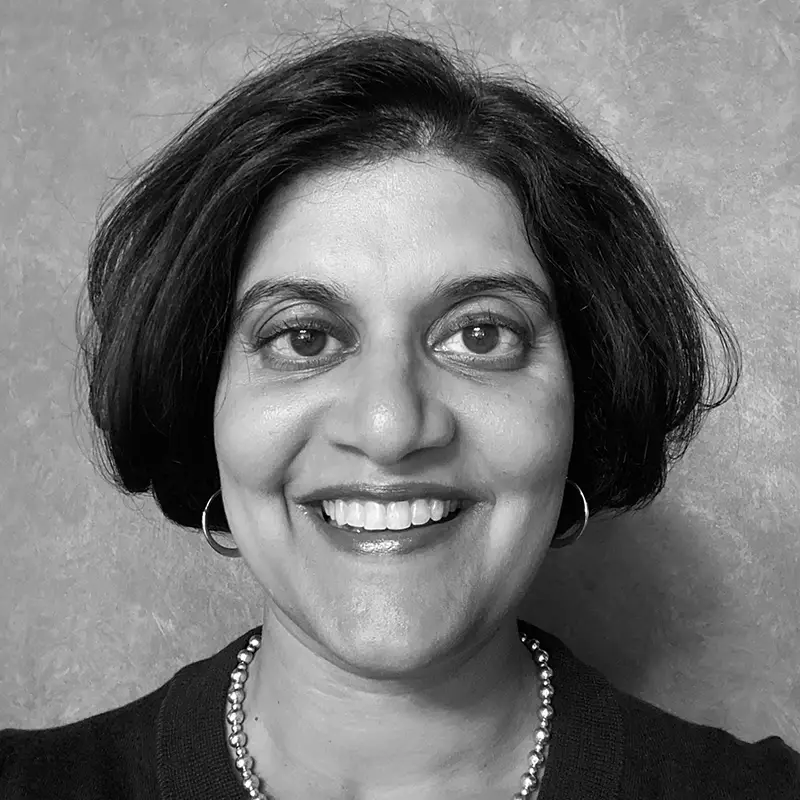
Seshagiri begins her lecture by drawing parallels between the narrator’s life and the students’ new experiences.
“Although his story begins in 1964 in India, which seems to us very distant in time and space from our present moment, it’s about a young person who leaves home to be a student in an unknown place,” Seshagiri tells them. “He has to learn to be independent and to take responsibility, not only for his education, but for his food and his finances, and his housing; he has to learn to live with a new roommate. In his case, it’s his wife (through an arranged marriage), a woman he does not know at all.”
Whether the new UT students come from Knoxville, another state, another country, or are the first in their family to attend college, she tells them, “The land of the Vols might feel a little bit like alien terrain to you.”
The narrator’s arrival in the United States on the same day humans first landed on the moon, July 20, 1969, allows her to discuss the interdisciplinary nature of life and learning.
“It is, of course, not a coincidence that the word ‘university’ contains the word universe, or that the moon landing depended on the workings of multiple disciplines,” Seshagiri noted. “We had to advance our knowledge of mathematics, physics, astronomy, engineering, computational science, geology, celestial cartography, and that’s just to scratch the surface.”
“There is so much more that went into the moonshot than the preparation of the shuttle, the rockets, the astronauts, and their well-being,” she continued, naming historians, politicians, speech writers, journalists, translators, and more.
Seshagiri prompts today’s students to see the university not as a set of separate, disjointed programs and disciplines, but to recognize the interrelatedness in vast bodies of knowledge and to seize the opportunities to ask big questions.
“The purpose of the university is not to shape you into someone’s future employee or to make you a cog in someone else’s machinery,” she told them.
Instead of taking courses only because they fulfill requirements, the professor urged the students to see the university as both a map and a compass for plotting their own course.
“Your time is valuable, and you should enter every class believing that it will enrich your thinking and broaden your knowledge,” Seshagiri said. “You have a duty to yourself and the place you’ve earned here to make decisions about what sets you on fire. No single discipline has all the answers. We
inhabit our humanity to the fullest only when we embrace a multitude and multiplicity of ideas.”
The point hit home for several students. One wrote to Seshagiri in an email after the lecture, “As I applied to college and now that I’m here I have been focused on what career will bring in the most money, not what I will actually enjoy. Seeing your love and excitement for your profession, along with every other person I have interacted with, has shown me that happiness is just as, if not more, important.”
Unique Opportunities at UT
Another student wrote to Seshagiri, “I feel that sometimes it’s hard for students our age to find ways to relate to the literature we read or the classes we take. However, your talk was a great reminder for me of the importance of taking advantage of the stories I read and classes I take because they are shaping and impactful.”
“Recently it’s been easy for me, a little freshman still navigating the new college scene, to be intimidated by the resources in front of me … I fear I have not done enough or I’m ill-prepared to really become involved, while other members seem to already have it all together,” the student continued. “A main takeaway I had from your talk was that I have a unique opportunity here, and I get to choose what to do with it—something that should be exciting more than anything.”
While the program’s name comes from Homer’s epic poem about an exiled hero trying to find his way home amid monsters and other obstacles, Seshagiri told the students, “Odyssey in the Homeric singular is insufficient for our journey.”
“Here, it has to be Odysseys plural, because there are as many ways to traverse university’s avenues as there are students assembled within it, students who create avenues for themselves,” she said.
Even students who didn’t complete the story before attending the lecture understood the message. “I connected strongly and love the idea that everyone has their own path and personal odyssey that they will go on,” one student wrote to the professor. “It reminded me that life isn’t a single straight journey but a series of challenges and discoveries that shape who we are. That perspective encouraged me to think more about how my own experiences can influence the way I approach learning and growth, especially during my freshman year.”
The Odysseys program has made an impact on UT administrators and faculty members who have seen Seshagiri’ s lecture too.
In 2024, Dean Ellen McIntyre of the College of Education, Health, and Human Sciences, wrote to the leaders of UT’s Office of Student Success. “Dr. Seshagiri’s pedagogy was brilliant and provocative by asking tough questions in her gentle manner and inviting personality,” McIntyre’s letter said. “I sat among many students who did not move a muscle during the lecture, listening intently. I felt their urgency to learn from this lecture … Dr. Seshagiri pushed their thinking, helping them experience what a college education is all about.”
In fall 2025, Associate Professor Katy L. Chiles from the Department of English attended one of the sessions. “Attending Professor Seshagiri’ s Odysseys presentation was exactly the inspiration I needed to start the semester,” Chiles said. “It reminded me why I was crazy enough to want to be a university pressor and why I love what I get to do every day and why it is so important. She dared to tell these young people that they deserve a life of the mind and then gave them a little taste of it. At the end, I was both clapping and crying.”
Continuing the Student Journey
To further inspire students, when they attend the lecture they receive a copy of Lahiri’s book Interpreter of Maladies, which includes the story and won a 2000 Pulitzer Prize. Each copy contains a bookplate from the College of Arts and Sciences and the Department of English welcoming students to the University of Tennessee.
While “The Third and Final Continent” has worked beautifully for the Odysseys program, Seshagiri said, she’d also love for students to be able to examine their lives, education, and potential futures through other works in the humanities, such as a poem, a short film, or a painting.
by Amy Beth Miller