
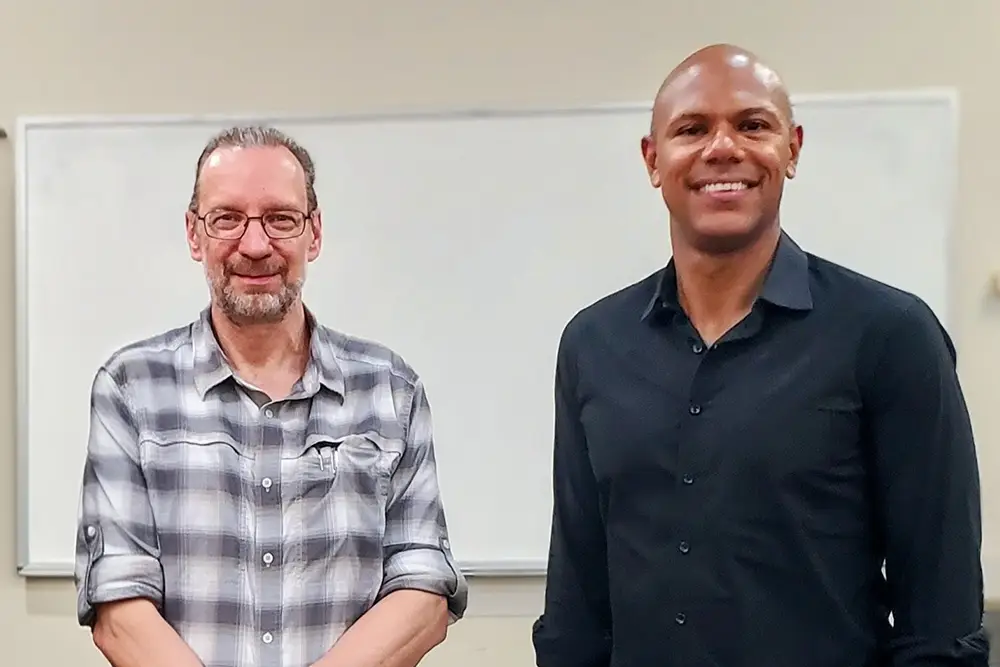
The Center for Social Theory creates a crossroads for interdisciplinary research in social and cultural theory.
The Center for Social Theory launched in 2025 to support research and teaching faculty and graduate students working in the areas of social and cultural theory. Professor Harry F. Dahms, Department of Sociology, directs the center as it builds community and provides opportunities for theoretical contributions in social sciences and humanities to enhance the quality of research and teaching across disciplines.
“Given that the center is quite new, it is still in the ‘experimentation phase,’” said Dahms. “The first order of business was to determine how many colleagues at UT are doing theoretical work, interested in social theory, and fluent in various theoretical frames, paradigms, and traditions.”
More than 50 faculty members from multiple departments in the College of Arts and Sciences are now involved with the center, representing sociology, philosophy, English, history, religious studies, political science, geography, and anthropology.
“The second task was to determine which topics were likely to attract the most interest and the largest audiences,” said Dahms. “The first emphasis area is American society and modernity. Others include applied social theory; constellations of past, present, and future; film, television, literature; governance and law in the 21st century; mass and social media; technology and society; and higher education.”
Building Practice for Social Theory
Dahms hopes the resulting interdisciplinary involvement will translate into high-quality, relevant research and publications that also enhance pedagogy and enable participants to achieve their research goals.
“My personal criterion for success is the organizing and facilitating of events that members do not want to miss,” said Dahms. “To this end, we provide different types of venues for faculty and graduate students to discuss issues, themes, and literatures in ways that don’t otherwise happen.”
The center also provides a path for graduate students to earn an interdisciplinary graduate social theory certificate at UT. Students choose up to four theory-course seminars from their home department and at least two theory courses from other departments to fulfill the basic requirement, plus a presentation that functions as the certificate capstone requirement in which they explain how social theory enhanced the quality of their work—typically their dissertation—and the contribution it made.
Creating Opportunity to Talk Social Theory
The first event hosted by the center in 2025 was a lecture by Mugambi Jouet, University of Southern California’s Gould School of Law, that provided several reference frames for how to view the present condition and possible futures of the West. This was followed by a conference in June that asked “what is real” in this era of accelerating social changes and technological advancements. Other opportunities for engagement have included:
- Sociologist Jenny Davis, Vanderbilt University, spoke in the context of the AI TENNessee Initiative about artificial intelligence and the issue of reparations; the title of her presentation was “After Algorithmic Fairness: The Myth of Neutrality and Power of Repair.”
- Oded Nir, professor of Hebrew Studies at Queens College in New York, showed and discussed an Israeli film in a cinema-studies class and gave a workshop about Israeli film titled “Space and Capitalism in Contemporary Hebrew Film.”
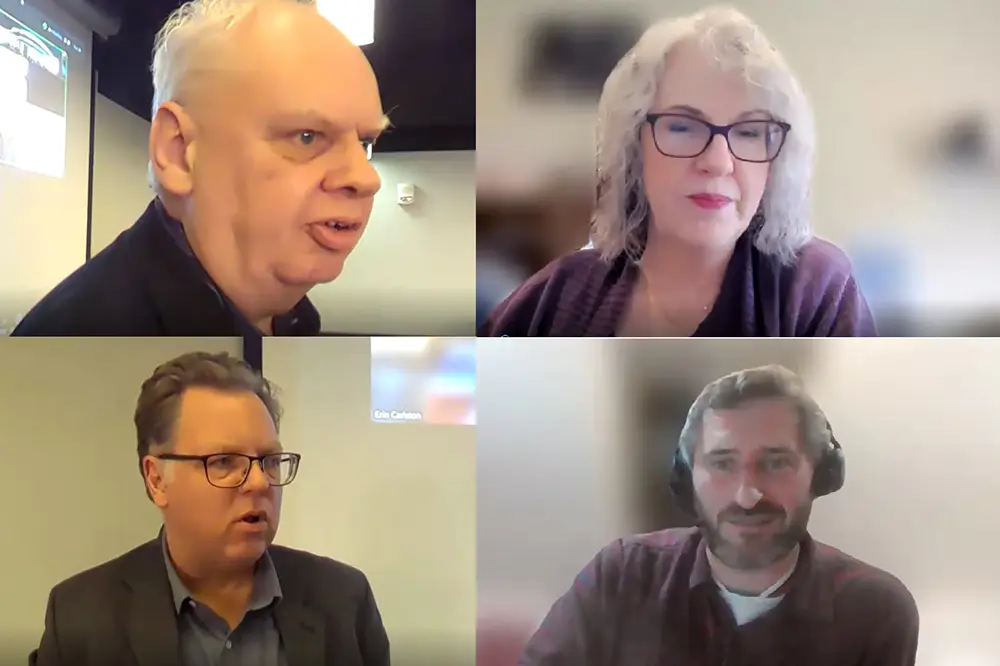
- Professor Martin Griffin, Department of English, participated in a discussion of his recent book on espionage novels since World War I, along with two historians from UT Knoxville and an English professor from the University of Auckland, New Zealand.
The center also cosponsored several events organized by a lecturer of Jewish Studies in the Department of Religious Studies as well as a lecture in philosophy. The center’s social theory reading group is coordinated by Associate Professor R.D. Perry, Department of English, and Professor Allen Dunn, Department of Philosophy.
“We currently are planning a symposium about artificial intelligence with two other centers—the Denbo Center for Humanities and the Arts and the Center for Social Complexity,” said Dahms. “Also in the works are an annual conference focusing on ‘What is Social Theory … in the 21st Century?’ and a workshop on film and theory in the summer.”
by Randall Brown